I started by deciding what the product genuinely needed, then built the system in code and created a practical AI workflow to keep React, Storybook and Figma in sync — without asking automation to make design decisions for us.
The decisionTurn the decisions the team repeats into foundations that are inspectable in both code and Figma.
Led foundations, API reduction and the bridge between design and implementation.
[01.00]>Work out what was worth keeping
The product did not need a bigger component library. It needed fewer decisions that the whole team could understand and reuse.
[01.01]>Diagnosis
We had plenty of components. That was part of the problem.
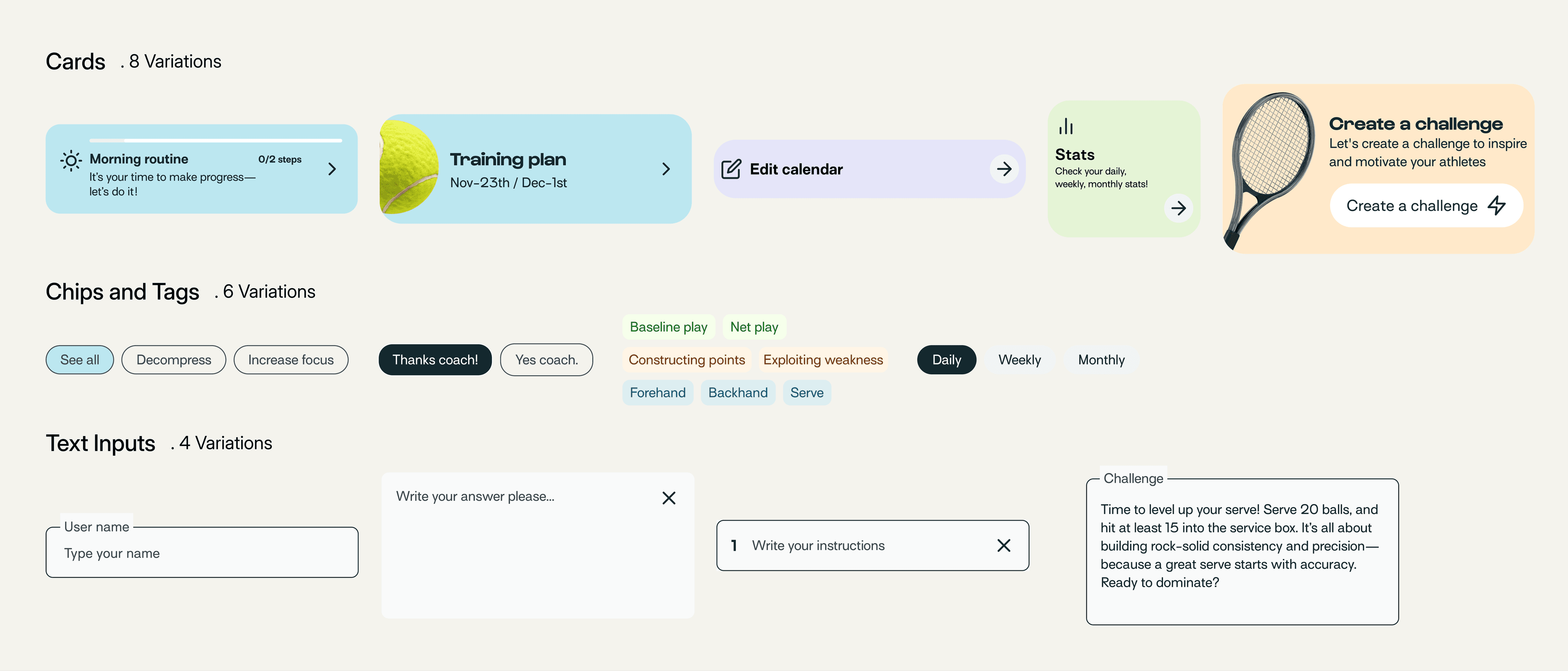
TAP Mindset had grown one sprint at a time. We ended up with eight kinds of card, six chips and four inputs, often doing almost the same job. Documenting a single component took 45–60 minutes, so it was understandably postponed whenever the roadmap became busy. The real system lived in people’s heads.
[01.02]>Why it mattered
The team was paying for the same decisions again and again.
A full documentation pass meant more than 30 hours of repetitive work before we had even moved a feature forward. I wanted the shared route to be the easiest route — useful enough that nobody needed to create an exception just to keep working.
[01.03]>The audit
I stopped drawing and started counting.
At that point, I decided not to design another component until I understood what we already had. I mapped the product flow by flow and inspected more than 28,000 component instances.
The numbers changed the conversation. They showed which patterns the product truly depended on, which ones were duplicates and which ones had simply survived because nobody had challenged them.
[01.04]>What changed
The maintenance problem
The difficult part was not creating a design system. It was making one the team could keep useful while the product continued to move.
[02.00]>Build it where the team could use it
The system became useful when a designer could understand it in Figma and an engineer could inspect the same decision in code.
[02.01]>Starting with the foundations
I made the core decisions before I automated anything.
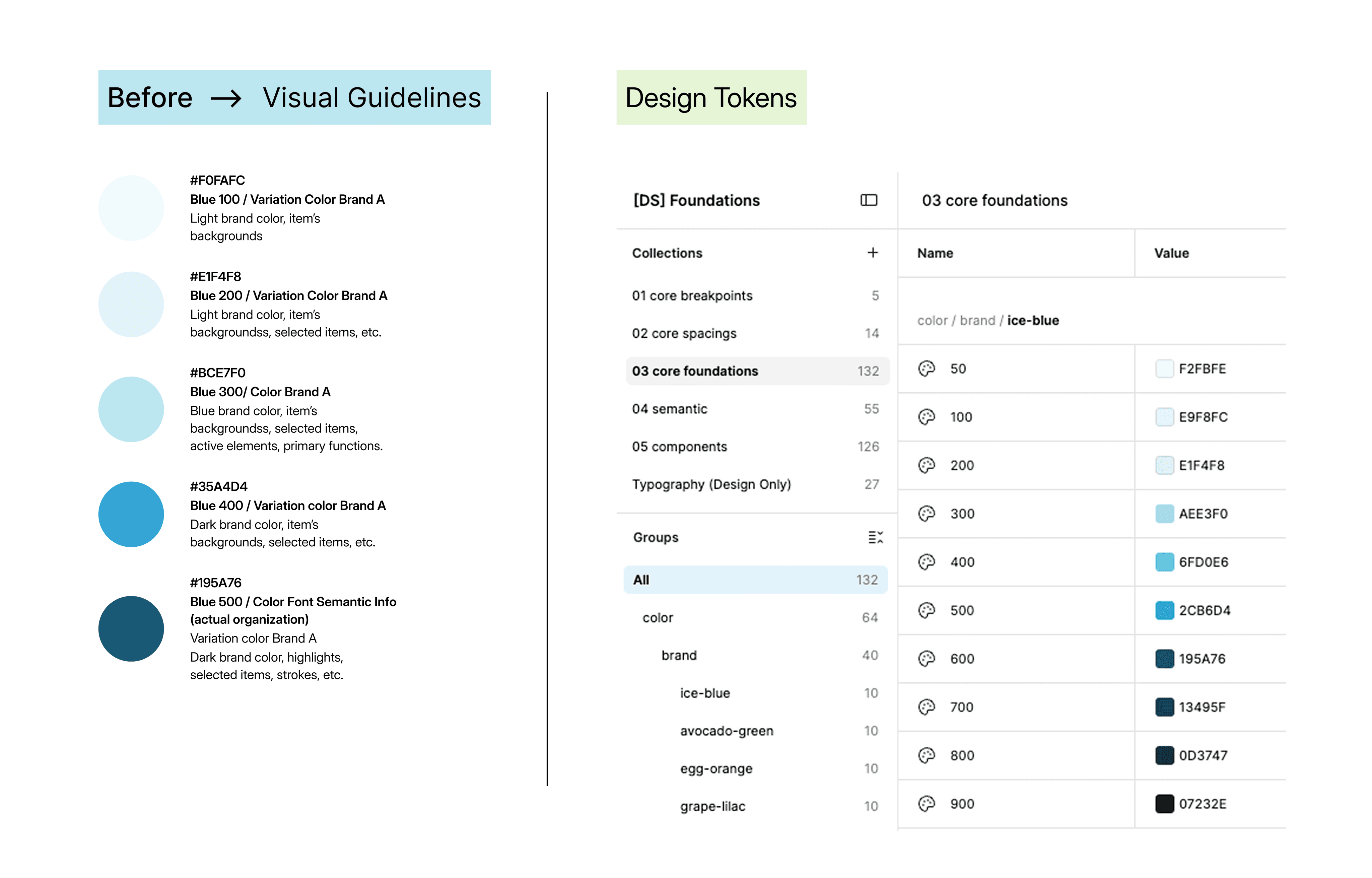
With the audit in front of me, I decided to rebuild from the foundations up: colour, type, spacing, elevation, radius, grid and motion. AI could help later, but automating a weak rule would only spread it faster.
Then I used the evidence to reduce 55 public concepts to 38. I merged duplicates, kept the patterns the product actually relied on and retired the rest.
[02.02]>How it works
A design decision has one path through the system.
Once the foundations were stable, I got to work on the coded system. I turned tokens into CSS properties, design choices into TypeScript props and component behaviour into inspectable stories.
I published the implementation because I wanted the technical story to be checked, not simply believed. Tokens, React components, stories and tests live together in the same repository.
Tokens
A JSON value is transformed into a CSS custom property
Components
TypeScript props define the React component’s public options
Checks
Storybook makes states, accessibility and behaviour visible
Storybook gave Design and Engineering the same reference point.
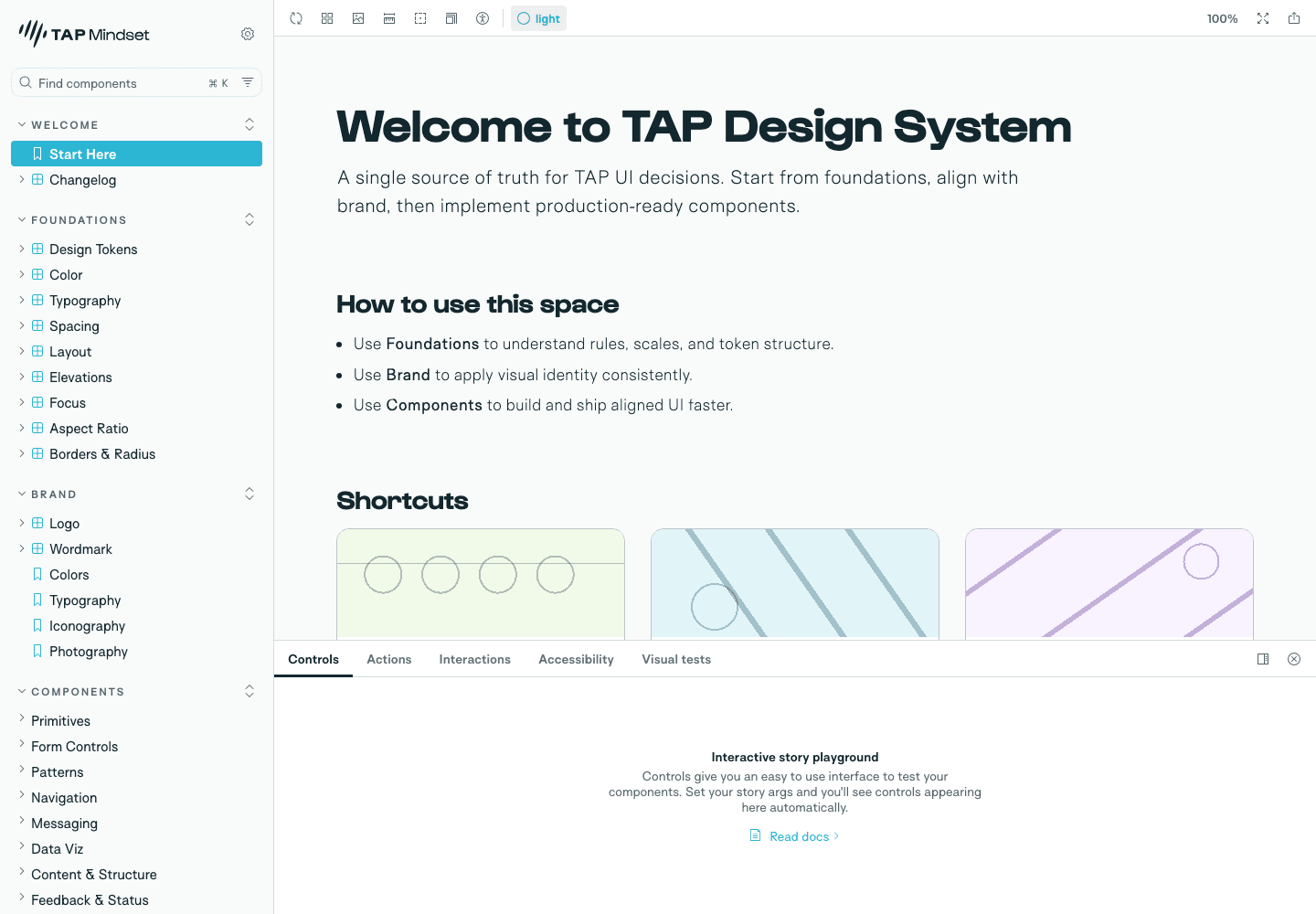
The next decision was where the team should meet. I chose Storybook because it could show foundations, brand rules, real components and their documentation in one place.
That changed the handoff. A designer could check intent and states; an engineer could inspect the API and implementation without translating a separate specification. The repository is public, so each claim here can be followed into a working story or the code behind it.
I automated the parts nobody should have to copy by hand.
At first, I was still treating Figma as the place where the system had to be recreated and maintained. I changed my position once the coded component became the more reliable description of what actually shipped.
So I built a TypeScript catalogue builder, a component importer and a documentation generator. The catalogue reads props, variants, booleans, slots, defaults, CSS token references and Storybook metadata. The plugins carry that structure into Figma instead of guessing from a screenshot.
Reads the coded component catalogue and rebuilds an editable component structure in Figma. Visual adapters handle the places where arbitrary JSX and CSS cannot be translated safely.
Turns a selected component set into linked Overview and Variants & states documentation. If validation fails, it reports the stage and removes the temporary frames.
The plugins carried structure, not judgment. Code could expose variants, slots and tokens; it could not decide whether a pattern should be one component or five, how properties should be grouped, or when an interface needed to hug or fill. That became the boundary of the system.
[03.00]>Use AI without giving away the decisions
AI saved time once we gave it good context, a narrow job and a clear point where a person had to review the result.
[03.01]>Where AI helped
AI was useful after the rules were clear — not before.
Only then did I bring AI into the workflow. I used it to find repetition, explore edge cases, prepare documentation and speed up implementation.
I also changed how I thought about it. The useful question was no longer ‘what can AI generate?’ but ‘which decisions are clear enough to delegate safely?’ It could extend an explicit pattern. It could not redefine foundations, change the public API or make accessibility decisions without review.
Find
Spot repeated patterns and possible drift
Prepare
Draft documentation and implementation starting points
Check
Compare Figma, tokens and Storybook before release
Stop
Return foundation, API and accessibility decisions to a person
[03.02]>How the team used it
The system stopped belonging to one designer.
By the end, three product designers and two engineers were using the library in day-to-day product work. Foundations, component decisions and documentation had moved out of individual files and into places everyone could inspect and question.
It is still being used after my direct involvement. For me, that is the strongest result: the team can extend the product without needing me to return and explain the original decisions.
5 people
3 product designers · 2 engineers
Shared decisions
Design and Engineering review changes together
Still in use
The library remains part of the product workflow
[03.03]>Keeping it healthy
We made maintenance part of the team’s routine.
I introduced a weekly Design and Engineering review, gave each layer a clear owner and added release checks for parity between tokens, Figma and Storybook. Automation could prepare the work and flag inconsistencies. A person still approved any change that affected foundations, the public API or accessibility.
The numbers were useful, but the failures taught me more. A parity check uncovered four brand scales that had quietly drifted apart. Poor context produced quick but inconsistent output. A version restore forced us to rebuild part of the consolidation. AI made good execution faster, and bad execution faster too.
28,000+Instances audited
55 → 38Component concepts
45 → <2 minDocumentation time
[03.05]>Evidence
The goal was never consistency. It was continuity.
Tools change. The system preserves the decisions that matter.