THE BRIEF
→Improve online top-ups.
THE QUESTION I CHOSE
Which commuting decisions could software responsibly remove?

I turned a narrow online top-up brief into a product that protects the passenger's goal, prepares the next decision and leaves consequential choices in human hands.
The decisionAutomate preparation, never a consequential action without a person seeing and approving it.
[01.00]>Read the burden
Improve online top-ups.
Which commuting decisions could software responsibly remove?
Before leaving, passengers checked balance, weather and timing. During travel they monitored delays and transfers. When the network changed, they compared alternatives and rebuilt the rest of the journey.
Balance, weather and timing before leaving.
Delays, transfers and remaining time.
Options when the network changes.
The rest of the journey after disruption.
I compared local operators, journey planners and mobility products across eight behaviours. I marked partial support instead of rounding it up: the opportunity only became visible when information, anticipation and consent were considered together.
Passengers repeat the same small decisions every day.
Real-time information only becomes valuable when a change is detected.
The cost of missing an important update is much higher than checking once.
People accept anticipation when it is clear why the intervention matters.
Goals stay stable. Routes, context and recommendations can change.
[02.00]>Define the agent
At that point, I changed my position. A better dashboard would still require the passenger to wake, check, decide and act every day.
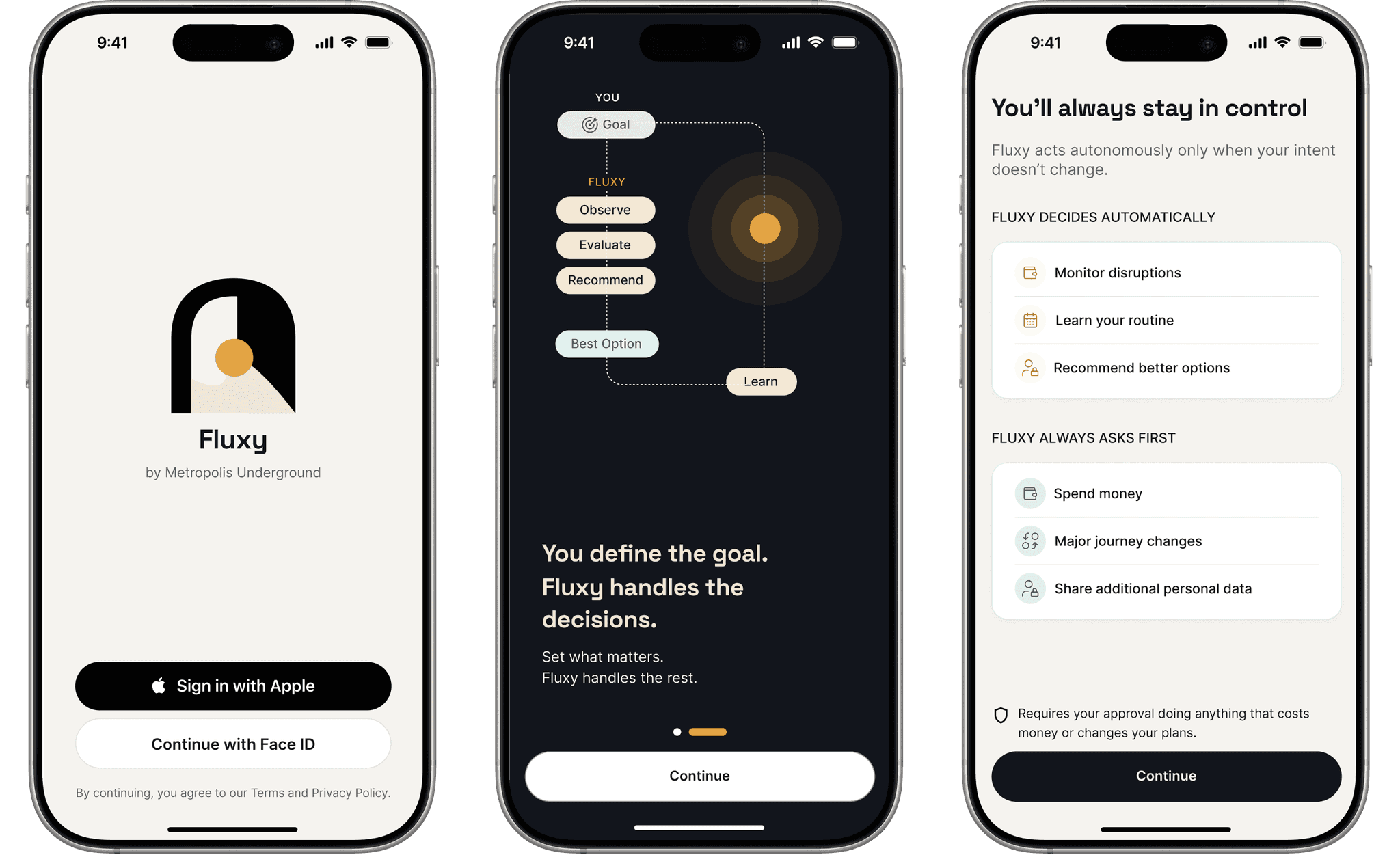
So I defined Fluxy as an agent that observes, anticipates and recommends continuously — then asks for approval at the boundary where human judgement matters.
I mapped the agent as a decision system: first understand the passenger's goal, then classify the impact of change before choosing whether to act, ask or step back.
Arrive before 08:45
Monitor balance, network and time
A disruption threatens the goal
Adjust the journey without interrupting the passenger.
No notificationPrepare the best alternative and ask before applying it.
Passenger decidesExplain the constraint honestly and preserve control.
No false promiseThe interface appears at the decision boundary — not before.
Start with a passenger goal, introduce a change in context and inspect the recommendation. The prototype makes the operating model tangible without pretending the agent should decide everything.
Open in a new tab[03.00]>Bound autonomy
These rules defined when Fluxy could stay silent, prepare context, ask for consent or admit the goal could not be protected.
WhenContext changes around a stable arrival goal.
Fluxy mayRecalculate and prepare a better option.
LimitNever change what the passenger is trying to achieve.
WhenRoutine information becomes consequential.
Fluxy maySurface only the next useful action.
LimitNo notification when nothing needs a decision.
WhenMoney, personal data or commitment is involved.
Fluxy mayStage the action and explain the reason.
LimitThe passenger approves before anything happens.
WhenFluxy cannot protect the original goal.
Fluxy mayExplain the constraint and the safest alternative.
LimitNo confident answer when the system is uncertain.
I translated fare policy, accessibility, operations and passenger trust into explicit autonomy rules, then used AI to simulate edge cases and produce auditable decision traces.
AI expanded scenario coverage. It did not define the boundaries: payment, personal-data expansion and major journey changes always remained behind human approval.
I translated the agent's behaviour into a semantic visual system. Paper is the only product background; amber is reserved for Fluxy speaking proactively; transit and alert colours describe system state rather than personality.
Trust is built through consistency, not personality.
 Fluxyby Metropolis Underground
 Fluxyby Metropolis Underground
Move with confidence.
CalmHelpfulPredictiveHuman
Confident, plain and transparent about every recommendation. Supporting text and error colours were deepened when the brand values failed WCAG AA — accessibility won over exact hex fidelity.
Everyday movement, with assistance present only when context makes it useful.


[04.00]>Make it testable
One glance replaces checks for balance, weather, timing and route confidence.
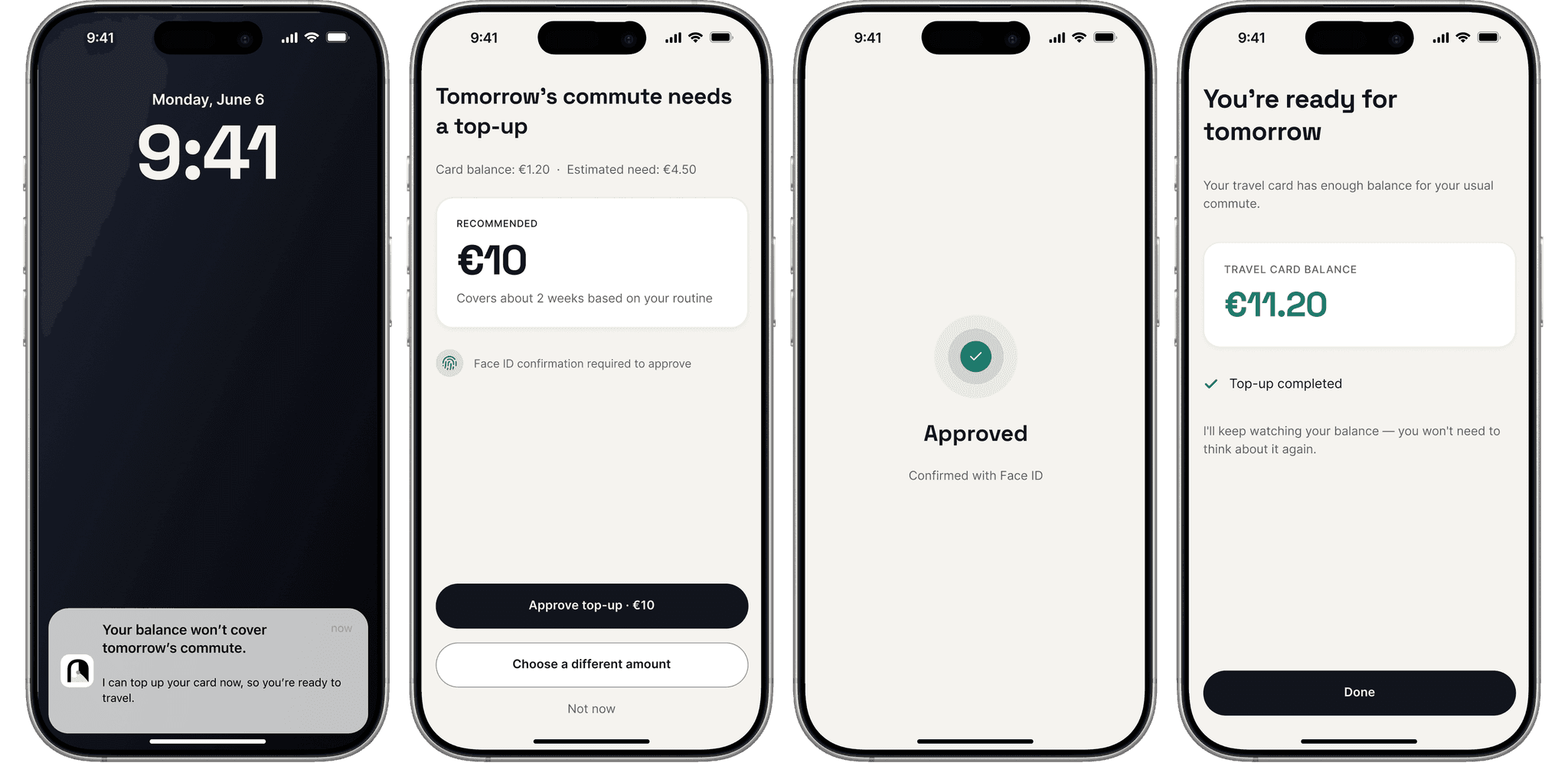
Fluxy monitors balance and stages the top-up. The passenger still authorises the transaction.
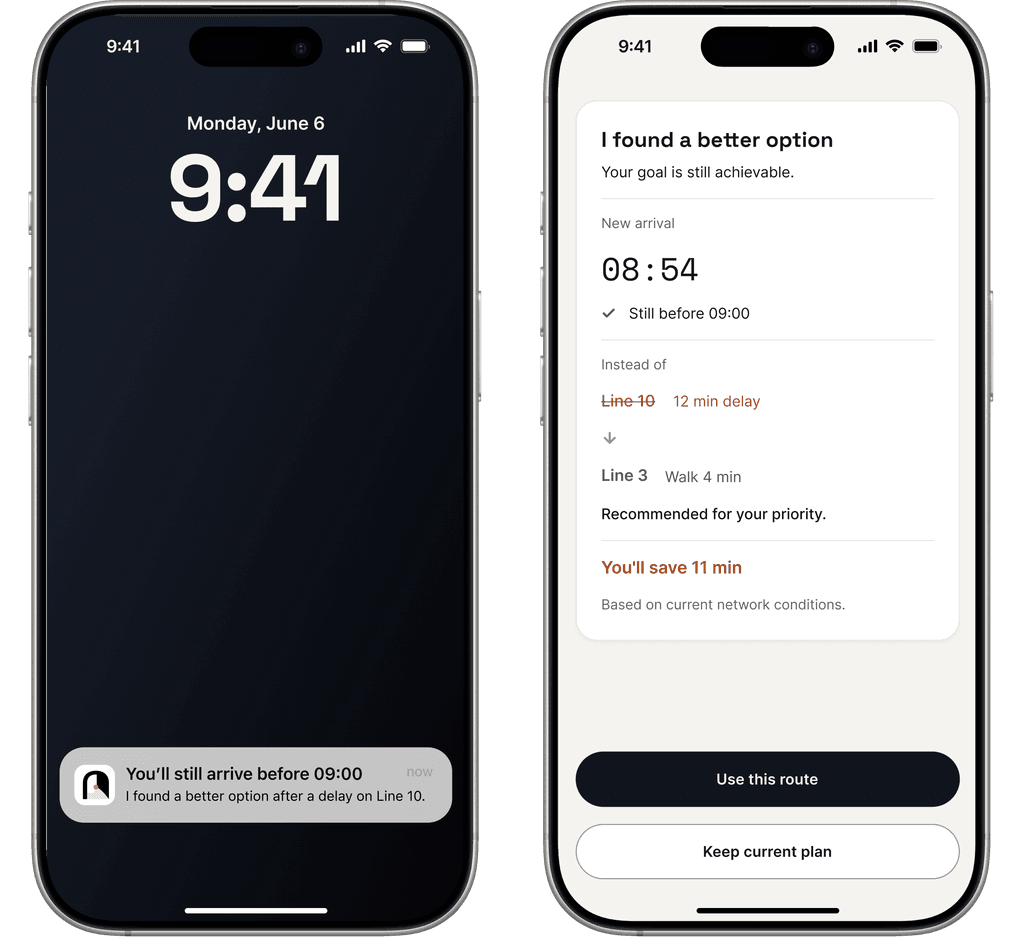
When disruption threatens arrival, Fluxy explains the trigger and recommends a route in terms of the passenger's priority.
One model connects the daily brief, low balance and disruption instead of treating them as separate features.
Clear boundaries distinguish what Fluxy may observe, prepare, recommend and execute.
A coherent language carries the same principles through product behaviour, interface and brand.
This is an independent concept, so I would not present prototype coherence as product impact. The next step is to test whether passengers understand why Fluxy intervenes, notice when consent is required and recover confidently when the original goal cannot be protected.
Software can monitor, prepare and recommend. Consequential decisions remain human.
> MORE WORK